Many traders enter the forex market with excitement but no real plan. They buy when price looks high, sell when fear appears, and often risk too much on one trade. This is why having clear Forex Trading Strategies is essential.
A strategy gives your trading structure. It tells you when to enter, where to exit, how much to risk, and when to stay out. Without a trading plan, forex trading becomes emotional guessing.
Before learning advanced methods, beginners should first understand What is Forex Trading and how currency pairs move in the global market.
Forex Trading Strategies are structured methods traders use to buy or sell currency pairs based on market analysis, price action, indicators, and risk management. A good strategy helps traders plan entries, exits, stop losses, and position sizes instead of making emotional trading decisions.
What Are Forex Trading Strategies?
Forex Trading Strategies are rules that guide your trading decisions in the foreign exchange market. These rules help you identify trade setups, manage risk, and avoid random entries.
A strong strategy usually includes:
- Entry rules
- Exit rules
- Stop loss placement
- Take profit target
- Risk-to-reward ratio
- Market condition filter
- Position sizing rules
For beginners, forex strategies help reduce confusion. For experienced traders, they support consistency and long-term performance.
Best Forex Trading Strategies Used by Traders
Different traders use different forex trading techniques. The best forex strategy depends on your time, skill, risk tolerance, and market conditions.
Trend Following Strategy
Trend following means trading in the direction of the main market trend.
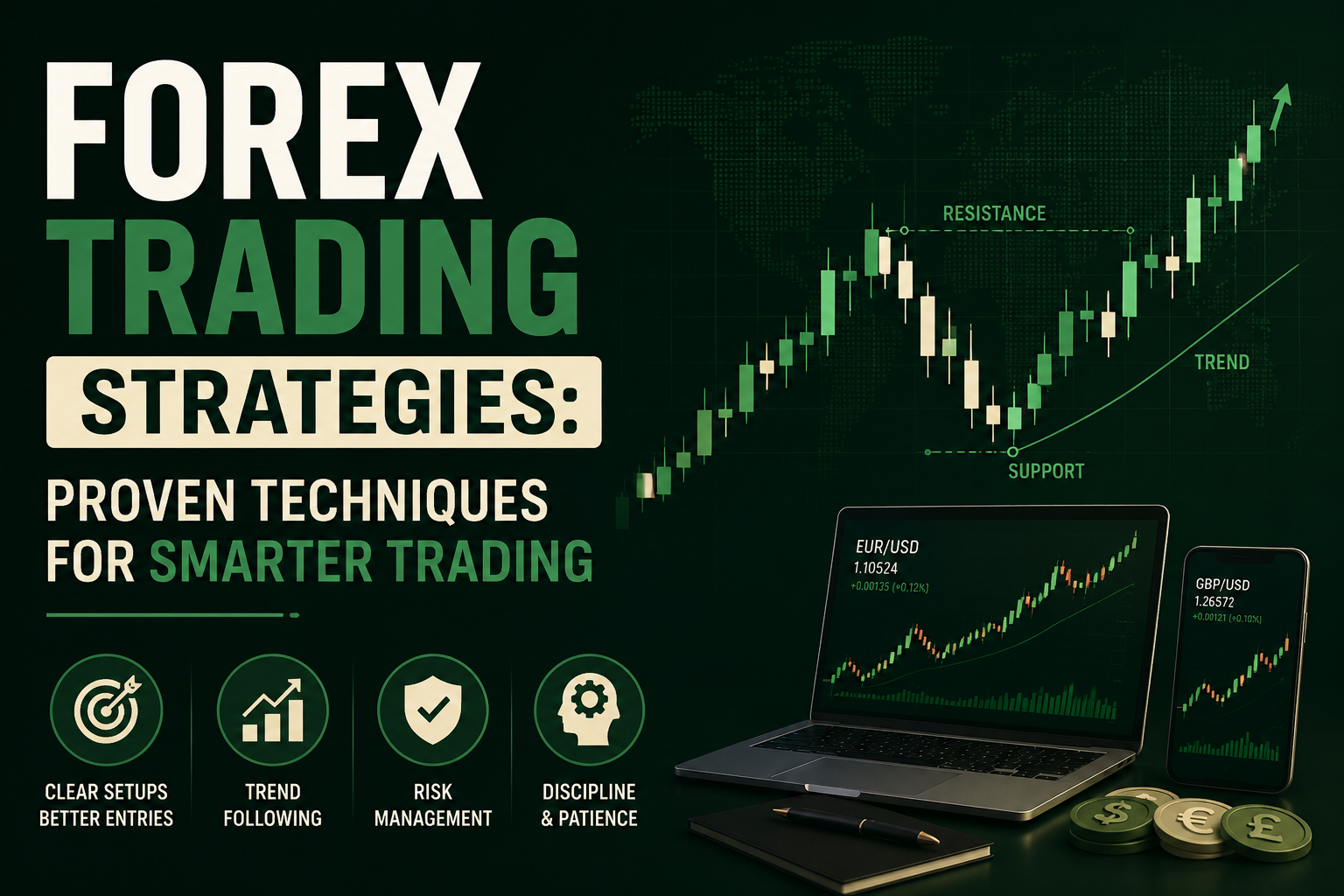
If EUR/USD is making higher highs and higher lows, traders look for buy opportunities. If price makes lower highs and lower lows, traders look for sell opportunities.
How it works:
- Identify the trend on a higher timeframe.
- Wait for a pullback.
- Confirm the entry with price action or an indicator.
- Place stop loss beyond the recent swing level.
Example:
If GBP/USD is above the 50-period moving average and pulls back to support, a trader may wait for a bullish candle before buying.
Breakout Trading Strategy
A breakout happens when price moves above resistance or below support with strength.
Breakout traders look for strong moves after price leaves a range. However, false breakouts are common, so confirmation is important.
Key indicators:
- Support and resistance
- Volume
- Moving averages
- Candlestick confirmation
Entry and exit idea:
A trader may buy EUR/USD after price closes above resistance. The stop loss can go below the breakout level, while take profit can target the next resistance area.
Scalping Strategy
Scalping is a fast short-term strategy. Traders enter and exit trades within minutes to capture small price movements.
Scalping works best when:
- Spreads are low
- Liquidity is high
- Execution is fast
- Market movement is active
However, scalping requires focus and discipline. It can be stressful for beginners because decisions must be quick.
Swing Trading Strategy
Swing trading means holding trades for several hours, days, or even longer. Traders try to capture larger market moves.
Swing traders often use:
- 4-hour charts
- Daily charts
- Support and resistance
- Trendlines
- Price action patterns
The benefit is that swing trading needs less screen time. However, trades may face overnight risk and news volatility.
Foreign Exchange Day Trading Strategy
Foreign exchange day trading means opening and closing trades within the same day. Traders avoid overnight exposure.
A day trader may use the London or New York session to find strong moves. For example, if USD/JPY breaks above a key level during the New York session, a trader may enter after confirmation.
Day traders should use strict daily loss limits. This prevents one bad day from damaging the account.
Forex Trading Techniques for Better Results
Good forex trading techniques improve decision-making. They do not guarantee wins, but they help you trade with more structure.
Useful techniques include:
- Technical analysis: Reading charts and price movement.
- Support and resistance: Finding key market levels.
- Moving averages: Identifying trend direction.
- Price action trading: Reading candles and market structure.
- Risk-to-reward ratio: Comparing possible loss to possible profit.
- Position sizing: Choosing lot size based on account risk.
To improve trade confirmation, study Best Forex Trading Indicators and learn how RSI, MACD, and moving averages support analysis.
How to Choose the Best Forex Strategy
The best forex strategy is the one you can follow consistently.
Ask yourself:
- How much time can I spend trading?
- Do I prefer fast or slow trades?
- Can I handle high-pressure decisions?
- What is my risk tolerance?
- Do I understand the market condition?
- Can I test the strategy on demo first?
If you have limited time, swing trading may suit you. If you can watch charts daily, day trading may work better. If you enjoy fast decisions, scalping may fit, but only after practice.
Timing also matters. Learn the Best Time to Trade Forex because liquidity and volatility change across sessions.
Common Mistakes Traders Make
Even good forex strategies fail when traders break rules.
Avoid these mistakes:
- Overtrading after one win or loss
- Ignoring stop losses
- Trading without a written plan
- Using high leverage
- Moving stop loss emotionally
- Entering trades late
- Copying others without understanding risk
- Changing strategy too often
A simple strategy followed with discipline is better than a complex strategy used emotionally.
Quick Comparison Table
Strategy | Timeframe | Risk Level | Skill Requirement | Suitable For |
Trend Trading | 1H to Daily | Medium | Beginner to Intermediate | Patient traders |
Scalping | 1M to 5M | High | Advanced | Fast decision-makers |
Swing Trading | 4H to Daily | Medium | Beginner to Intermediate | Part-time traders |
Day Trading | 15M to 1H | Medium to High | Intermediate | Active traders |
Conclusion
Forex Trading Strategies help traders make better decisions in the currency market. They provide rules for entry, exit, stop loss, take profit, and risk management.
The best forex strategy is not always the most complicated one. Instead, it is the strategy you understand, test, and follow with discipline.
Start with simple forex strategies, practice on demo, track your results, and protect your capital before using real money
Disclaimer
Forex trading involves significant risk and may not be suitable for all investors. The information provided in this article is for educational and informational purposes only and should not be considered financial or investment advice. Always conduct your own research and consult a qualified financial professional before making trading decisions.
The best forex strategy for beginners is usually trend trading or support and resistance trading. These methods are simple, visual, and easier to practice.
No strategy has a guaranteed success rate. A strategy works better when combined with risk management, discipline, and proper market conditions.
Foreign exchange day trading can be profitable for disciplined traders. However, it also carries risk, especially with high leverage and poor money management.
Professional traders choose strategies based on market conditions, risk tolerance, liquidity, volatility, and tested performance data.
Popular indicators include moving averages, RSI, MACD, Bollinger Bands, and volume tools. Indicators work best with price action.