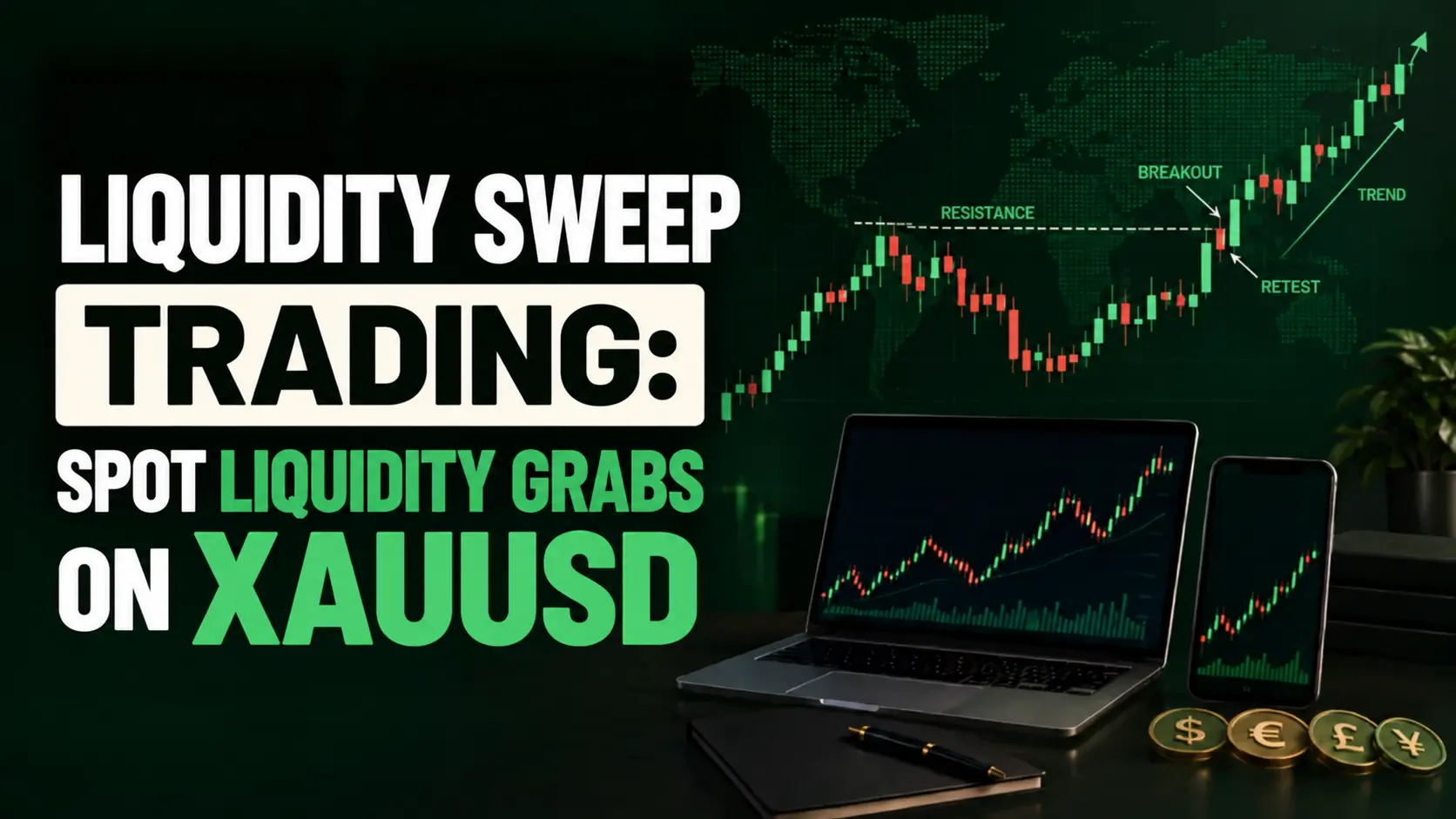
A liquidity sweep happens when price moves beyond a clear high or low and then turns back. On XAUUSD, these moves often form near prior session highs, equal highs or lows, swing points, and other visible liquidity zones. Traders use liquidity sweep trading to avoid chasing the first breakout and wait for price to react. A sweep by itself is not a trade signal. This guide shows how to mark liquidity, read a market structure shift, and build a simple liquidity sweep strategy with clear risk rules.
What Is a Liquidity Sweep in XAUUSD?
A liquidity sweep is a short move through a price level where many orders may sit. Price then rejects that area or moves back into the old range. Traders often watch prior highs and lows because stop orders and breakout orders can build around them.
A sweep does not prove that banks or funds “hunted stops.” The chart only shows the price. It does not show the intent behind every order.
Gold trades through OTC and futures markets. The World Gold Council names London OTC and COMEX as major gold trading centres.
Where Do Liquidity Grabs Usually Form?
Common liquidity zones include prior day highs and lows, equal highs and lows, swing points, range edges, support, resistance, and round numbers.
Buy-side liquidity usually refers to orders above visible highs. Sell-side liquidity refers to orders below visible lows. If XAUUSD trades through one of these areas and then returns inside the old range, traders may call the move a liquidity grab or sweep.
Use these zones with a clear price action strategy. Do not treat every wick beyond support or resistance as a valid setup.
How Do You Spot a Liquidity Sweep on XAUUSD?
Direct answer: Mark an obvious high or low. Wait for XAUUSD to trade beyond it. Then look for a firm move back through the level. A better setup may also show strong momentum or a market structure shift. Avoid entering only because one candle crossed support or resistance.
Use this four-step check:
- Mark a liquidity zone.
- Wait for the price to move past it.
- Look for a close back inside the old range.
- Confirm a break of a nearby swing in the other direction.
This can help separate a failed breakout from a stronger breakout.
What Is a Market Structure Shift After a Sweep?
A market structure shift is a break of a key short-term swing after the sweep. If price takes buy-side liquidity, a break below a recent higher low can support a bearish idea. If price takes sell-side liquidity, a break above a recent lower high can support a bullish idea.
This idea is common in smart money concepts. Still, it is a way to read a chart, not proof of hidden institutional activity.
Example of a Liquidity Sweep Strategy
Suppose XAUUSD forms equal highs near 4,360. Price later trades to 4,368, then closes back below 4,360. The visible highs have been swept.
A trader may then wait for a nearby short-term swing low to break. If that happens, the trader could watch for a pullback before looking for an entry. The stop can sit past the level that would make the idea invalid. The next sell-side liquidity zone can serve as a target reference.
This is a made-up example for learning. It is not a live trade call.
When Is Liquidity Sweep Trading Most Useful?
Liquidity sweeps can form at any time. Intraday setups may be easier to read when more traders are active. Session opens, session overlaps, and major news can all bring fast moves around key levels.
Review the forex trading hours and session overlaps before building a time-based plan. News spikes may look like sweeps but can keep moving.
Gold trades across OTC and exchange markets, with London and COMEX playing key roles. For more background on how the global gold market works, see the World Gold Council’s global gold market overview.
How Should You Manage Risk?
A liquidity sweep strategy can fail when the apparent rejection turns into a true breakout. Set your invalidation level before entry. Then size the trade from the distance to your stop.
Our forex risk management strategies guide covers stop placement and risk-to-reward planning. A lot size calculator can help keep risk consistent.
Final Thoughts
Liquidity sweep trading can help XAUUSD traders wait for evidence instead of chasing the first breakout. Better setups combine a clear liquidity zone, confirmation, and controlled risk. Test the method on old charts or a demo account before you risk real money.
Frequently Asked Questions
The terms are often used in the same way. Both describe price moving past a clear high or low where orders may sit. Some traders use “sweep” for a cleaner move through a zone and “grab” for a fast spike. There is no single market-wide rule that separates the two terms.
Buy-side liquidity refers to orders that may sit above visible highs. These can form above equal highs, prior session highs, or major swing highs. The area may hold breakout buy orders and stops from short trades. A move above the level followed by rejection may be read as a buy-side liquidity sweep.
Sell-side liquidity refers to orders that may sit below visible lows. These can include breakout sell orders and stops from long trades. If XAUUSD moves below a clear low and then quickly gets back above it, traders may read the move as a sell-side liquidity sweep.
No. Price can sweep a level and keep moving in the same direction. That is why a liquidity sweep should not be used alone. Traders often wait for a firm rejection, strong momentum, or a market structure shift before they decide whether the move looks more like a failed breakout.
Yes. Liquidity sweeps, liquidity zones, and market structure shifts are common ideas in smart money concepts. But these labels are only a way to read price action. A chart cannot prove who placed each order or why price moved. Use SMC as a framework, not as proof of institutional intent.