
Choosing between MT4 vs MT5 depends on your trading style, experience, and preferred markets. MetaTrader 4 (MT4) focuses mainly on forex trading, while MetaTrader 5 (MT5) offers more advanced charting tools, order types, and access to additional markets through supported brokers.
Both platforms allow manual and automated trading. However, neither guarantees better trading results.
Whether you are a beginner or an active trader, understanding the platforms can help you choose the right tools for your forex trading strategies.
What Is MetaTrader 4 and MetaTrader 5?
MetaTrader is trading software developed by MetaQuotes. It connects traders to supported brokers and provides tools for analysing prices, placing orders, and managing positions.
MetaTrader 4 (MT4)
MT4 is widely used for forex trading. It offers price charts, technical indicators, and automated trading through Expert Advisors (EAs).
Its familiar interface may suit beginners and traders who already use MT4-compatible tools.
The official MetaTrader 4 trading platform website explains its charting, order management, and automation features.
MetaTrader 5 (MT5)
MT5 is a multi-asset trading platform with additional analysis tools, advanced order management, and improved strategy testing.
It can support forex, stocks, and futures, depending on the broker.
According to the official MetaTrader 5 trading platform, MT5 also supports automated trading, copy trading, and broader market analysis.
MT4 vs MT5: Key Differences Explained
Understanding the difference between MT4 and MT5 helps traders select software that matches their requirements.
1. MT4 vs MT5: Trading Markets
MT4 mainly focuses on forex, although brokers may offer other instruments through CFDs.
MT5 supports a broader range of markets, including forex, stocks, and futures, where available.
Traders who focus only on currency pairs may find MT4 sufficient. Those seeking broader market access may prefer MT5.
2. Chart Timeframes
MT4 offers 9 chart timeframes, while MT5 provides 21.
The additional timeframes in MT5 allow traders to study market movements in greater detail. However, MT4 still provides useful charting options for common trading methods.
3. Technical Indicators
MT4 includes 30 built-in technical indicators, compared with 38 in MT5.
Both platforms allow custom indicators. Traders who use support and resistance trading can analyse price levels on either platform.
MT5 offers more built-in analysis options, but successful trading depends on how tools are used.
4. Pending Order Types
MT4 supports 4 pending order types, while MT5 provides 6.
MT5 includes buy stop-limit and sell stop-limit orders. These allow traders to set more specific conditions for entering the market.
Both platforms also support stop-loss and take-profit orders for trade management.
5. Automated Trading
Both platforms support Expert Advisors, which are programs that follow predefined trading instructions.
MT4 uses MQL4, while MT5 uses MQL5.
An automated system designed for MT4 generally cannot run directly on MT5 without modification or a compatible version.
6. Strategy Testing
MT4 has a single-threaded strategy tester for evaluating automated trading systems.
MT5 supports multi-threaded and multi-currency testing, allowing more complex strategies to be tested.
However, historical test results cannot predict future market performance.
7. Economic Calendar
MT5 includes a built-in economic calendar that displays scheduled financial events.
MT4 does not include the same native calendar feature. Traders can still monitor economic announcements using external resources.
This feature may help traders prepare for periods of increased market volatility.
8. Market Depth and Position Management
MT5 includes advanced Depth of Market features, which display available order information when supported by the broker.
It also supports hedging and netting account systems.
MT4 primarily uses hedging-style position management and provides more limited market-depth functionality.
9. Trading Costs
Neither platform is automatically cheaper.
MT4 and MT5 are generally free to download, but brokers determine the trading costs.
These may include spreads, commissions, overnight financing, and other account fees.
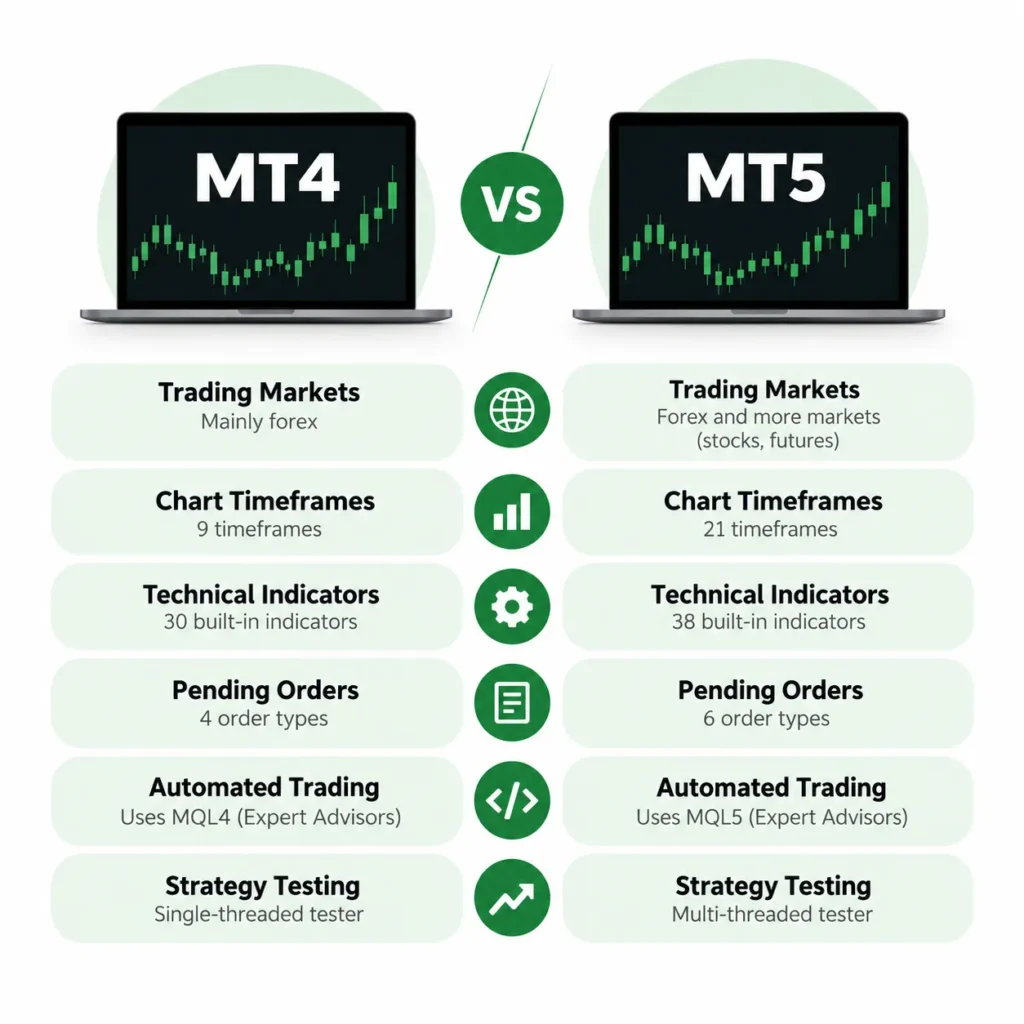
The MT4 vs MT5 comparison highlights key differences in trading tools and features.
MT4 offers a simple, forex-focused experience, while MT5 provides advanced charting and automation.
Both platforms suit different trading needs and experience levels.
MT4 vs MT5: Trading Fees and Account Costs
The actual cost of trading depends more on your broker than your MetaTrader platform.
A spread is the difference between the buying and selling prices. A commission is a separate fee charged by some brokers.
Traders should also check overnight charges and withdrawal conditions before opening an account.
Position sizing matters as well. A forex lot size calculator can help estimate trading volume based on account size, stop-loss distance, and planned risk.
MT4 vs MT5: Which Is Better for Gold Trading?
Both MT4 and MT5 can support XAUUSD, the market symbol for gold priced against the US dollar.
MT4 may suit traders who prefer familiar charting tools and existing indicators.
MT5 provides additional analysis features, which may appeal to traders using more detailed technical methods.
However, gold prices can change quickly during major economic events. Traders following XAUUSD trading signals should check entry levels, stop-loss placement, and market conditions before placing trades.
Neither platform removes the risks associated with gold trading.
MT4 or MT5: Which Should Beginners Choose?
MT4 may be easier for beginners who want to focus on forex trading without exploring too many additional features.
MT5 may be suitable for traders who want more charting options, additional order types, and wider market access.
Beginners should consider using a demo account before trading with real money.
Learning order placement, stop-loss management, and basic platform functions is more important than choosing software based only on its features.
Conclusion
The MT4 vs MT5 comparison shows that both platforms offer useful tools for forex traders. MT4 provides familiar trading features, while MT5 offers more charting options, advanced testing, and wider market support.
The right platform depends on your trading goals, broker, and preferred strategy.
Regardless of which platform you choose, applying effective forex risk management strategies is essential for managing market uncertainty and protecting trading capital.
Frequently Asked Questions
MT5 offers more built-in tools, timeframes, and advanced testing features. However, MT4 may suit traders who prefer its familiar interface or already use compatible trading systems.
Most custom MT4 indicators cannot run directly on MT5 because the platforms use different programming languages. A compatible version or code conversion may be necessary.
Both platforms are generally free to download. However, broker spreads, commissions, and other trading charges may apply.
Open positions cannot normally be transferred directly between the platforms. Account migration and position handling depend on the broker.
Yes. Both platforms can support XAUUSD when the broker offers the instrument. Trading conditions and contract specifications vary between brokers.