
What is ICT trading? ICT stands for Inner Circle Trader, a price-action trading approach developed by Michael J. Huddleston. It studies market structure, liquidity, price imbalances, and trading sessions to identify possible entries and exits.
Unlike strategies built mainly around indicators, ICT trading focuses on how prices behave near important chart levels.
Forex and gold traders use ICT concepts to plan trades, but these patterns cannot reliably reveal every institutional order or guarantee future price movements.
This approach shares several principles with forex trading strategies, particularly price-action analysis.
This guide explains the main concepts, practical ICT trading strategies, and how to evaluate XAUUSD setups while controlling risk.
What Is ICT Trading and How Does It Work?
ICT trading interprets price movements through liquidity, market structure, and changes in buying or selling pressure.
The approach assumes that areas around visible highs and lows may attract trading activity because stop orders and pending orders can cluster there.
Traders observe what happens when price reaches these areas instead of entering solely because a level has been touched.
The challenge is interpreting these movements consistently without assuming every sharp move comes from institutional manipulation.
Key ICT Trading Concepts Beginners Should Know
Understanding the terminology makes ICT charts easier to read.
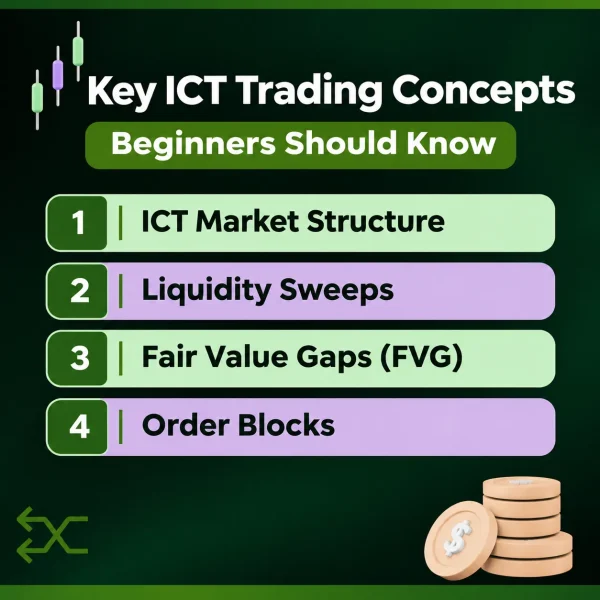
1. ICT Market Structure
Market structure describes the sequence of swing highs and lows.
Rising highs and lows suggest an upward trend. Falling highs and lows suggest a downward trend.
ICT traders also watch for a Market Structure Shift (MSS), where price action suggests a possible change in the short-term direction.
However, a broken swing level does not confirm that a lasting reversal has begun.
2. Liquidity Sweeps
A liquidity sweep happens when price moves beyond a visible high or low, then reacts or reverses.
ICT traders often monitor these moves around recent session extremes or equal highs and lows.
For gold, understanding liquidity sweeps in XAUUSD helps explain why a brief breakout should not automatically be treated as a confirmed trend.
A sweep provides context, not a standalone buy or sell instruction.
3. Fair Value Gaps (FVG)
A fair value gap is a three-candle pattern in which a rapid price movement leaves little or no overlap between the first and third candles.
Some ICT strategies watch for price to revisit this area before continuing in the original direction.
Not every fair value gap is revisited, and not every revisit produces a useful entry.
4. Order Blocks
An ICT order block generally refers to a selected candle or price zone before a strong directional movement.
Traders may use these zones as potential support or resistance.
The identification of order blocks involves judgement, and an apparent order block does not prove that institutional orders remain there.
Popular ICT Trading Strategies
Different ICT trading strategies combine the same concepts in different ways.
Liquidity Sweep and Market Structure Shift
This method starts by identifying a previous high or low.
The trader then watches for a sweep, followed by a change in short-term market structure.
A possible entry may be considered after a pullback, provided the setup has a clear invalidation point.
Fair Value Gap Entry
Traders first look for a strong price movement that creates an imbalance.
They then monitor whether price returns to the fair value gap.
Some traders require further price-action confirmation before entering.
ICT Day Trading and Session Timing
ICT day trading often concentrates on active market periods, particularly around the London and New York sessions.
Gold traders should understand gold trading hours because liquidity, spreads, and volatility can change throughout the day.
No trading session guarantees a successful setup.
How to Apply ICT Trading to XAUUSD
Gold can react quickly to economic releases, changes in interest-rate expectations, and movements in the US dollar.
ICT concepts trading can help organise chart analysis, but market news remains important.
What Is ICT Trading Strategy for Gold? A Practical Setup
Consider a hypothetical bullish XAUUSD setup:
-
- Identify the trend: Mark recent highs, lows, and important support levels.
-
- Wait for a sweep: Watch whether gold briefly falls below a previous low.
-
- Check structure: Look for price to move back above a recent short-term high.
-
- Find an entry area: Identify a relevant fair value gap or pullback zone.
-
- Plan the exit: Set a stop-loss level where the trade idea would no longer make sense.
This sequence describes a possible setup, not a prediction that gold will rise.
It can be assessed alongside established gold trading strategies.
Traders should also understand the wider market before using a chart pattern in isolation.
How to Identify ICT Trading Signals
An ICT trading signal should explain more than whether to buy or sell.
A useful trade plan identifies the market direction, entry conditions, stop-loss location, and potential exit area.
For XAUUSD, an alert may become easier to evaluate when it includes supporting price-action context.
Signals remain uncertain, even when several chart patterns appear to agree.
ICT Trading Risks and Common Mistakes
ICT terminology can make a chart appear more predictable than it really is.
Common mistakes include:
-
- Treating every liquidity sweep as a reversal.
-
- Assuming a fair value gap must be filled.
-
- Entering without checking the broader trend.
-
- Ignoring news-related gold volatility.
-
- Taking oversized positions after several chart confirmations.
Proper risk management remains essential.
The U.S. Securities and Exchange Commission explains important day trading risks, including how leverage can increase potential losses. These risks are also relevant when evaluating ICT trading setups.
Traders must consider the amount they could lose before deciding how much to trade.
A consistent risk plan should account for leverage, stop-loss distance, and changing market conditions.
The US Commodity Futures Trading Commission also highlights forex trading risks, including the dangers associated with leveraged trading.
Conclusion
Understanding what is ICT trading starts with learning how liquidity, market structure, and price imbalances are interpreted.
These concepts can help traders build structured forex and XAUUSD trade plans, but they should never replace independent analysis or risk controls.
Elite XAUUSD Signals publishes gold trading signals and XAUUSD analysis that traders can evaluate alongside their own ICT setups.
Frequently Asked Questions
ICT trading is a price-action method that uses liquidity levels, market structure, and price imbalances to identify possible trading opportunities.
Beginners can study ICT concepts, but interpreting them requires practice. Learning basic chart reading and testing setups on a demo account is sensible.
Yes. Traders apply ICT concepts to XAUUSD charts, including liquidity sweeps, fair value gaps, and market structure shifts.
ICT is a specific trading framework associated with Michael J. Huddleston. Smart Money Concepts is a broader label often used for similar ideas involving liquidity and market structure.
No. ICT setups can fail, and traders can experience losses due to volatility, incorrect analysis, leverage, and execution conditions.
ICT trading can be applied to different timeframes. Traders often use higher timeframes to identify market direction and lower timeframes to refine entries. The ideal timeframe depends on the trading strategy and risk tolerance.
An ICT kill zone is a specific trading period when traders look for potential setups, often around the London or New York sessions. These periods may experience increased activity, but they do not guarantee profitable trades.
Price action trading examines price movements and chart patterns. ICT trading uses price action with specific concepts such as liquidity sweeps, fair value gaps, order blocks, and market structure shifts.
A bullish ICT setup may form when gold sweeps a previous low, moves back above a short-term high, and retraces toward a fair value gap. Traders should confirm the setup and define their risk before entering.
Yes. ICT concepts can be applied to XAUUSD scalping using lower timeframes, liquidity levels, and market structure changes. However, gold's volatility, spreads, and execution costs can increase trading risks.